
The Best Hikes in the Black Hills — And When to Experience Them
The Best Hikes in the Black Hills — And When to Experience Them
Most hiking lists tell you where to go.
Fewer tell you when to go.
In the Black Hills, timing changes everything. Light shifts the color of granite. Wildlife moves differently by hour. Wind rises and falls across ridgelines. Trails that feel crowded at midday can feel completely solitary in the early morning or late evening.
After years guiding in this landscape — and many more exploring it personally — I’ve come to believe that knowing when to hike is just as important as knowing where.
Here are a few of my favorite hikes, paired with the times and seasons when they feel most alive.
Early Morning: Cathedral Spires & Little Devil’s Tower
If you want to feel the Black Hills wake up, start early.
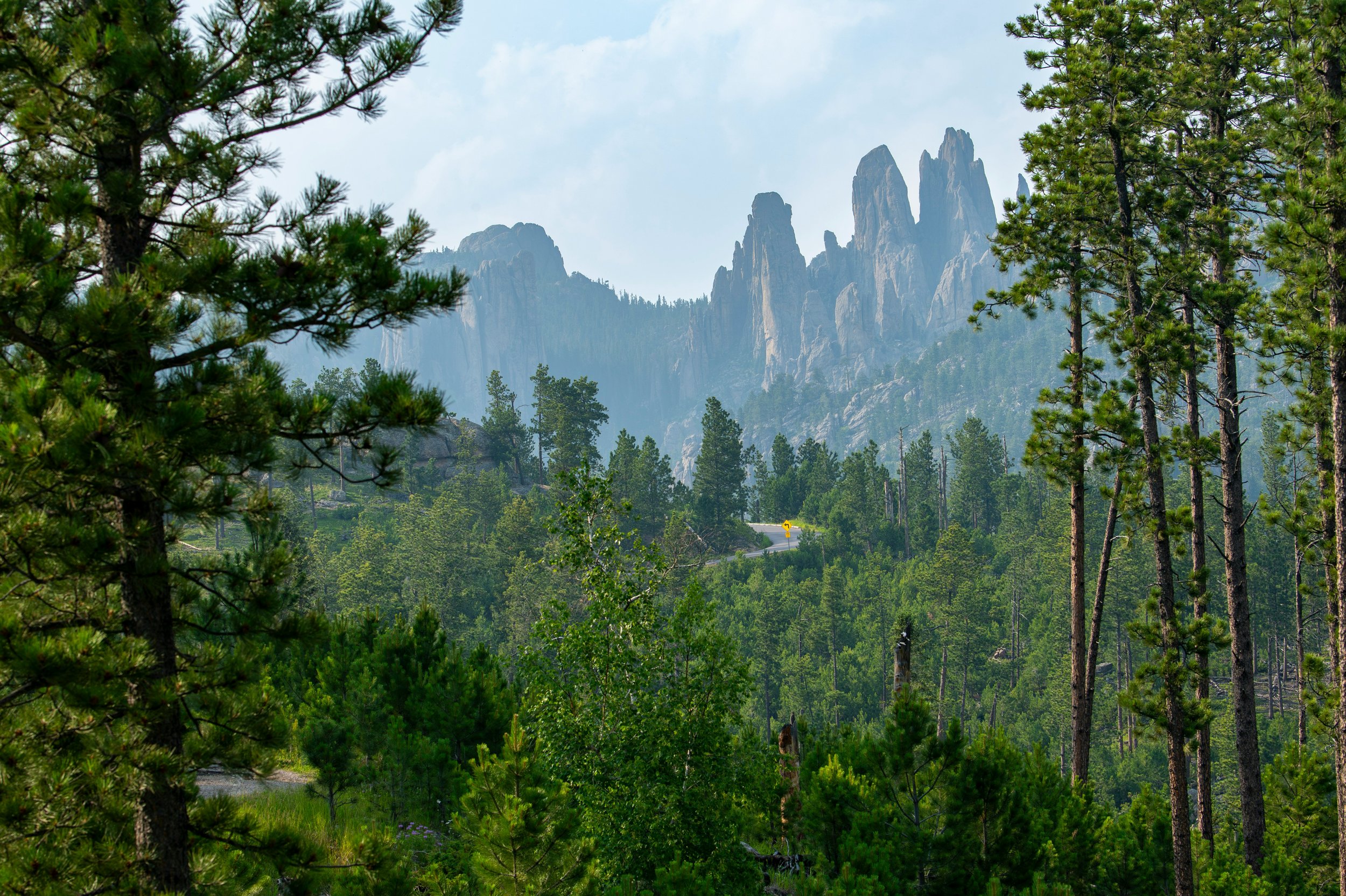
The Cathedral Spires trail is best experienced shortly after sunrise. The granite warms slowly in the morning light, turning from cool gray to soft gold. Wildlife is more active. The air is still. You’ll often hear the forest before you see it — wind in pine needles, distant birds, the quiet rhythm of boots on trail.
Little Devil’s Tower offers a slightly longer climb with expansive views. In the early hours, you’ll likely share it with only a handful of other hikers.
By mid-morning, both trails grow busier.
Go early, and you’ll understand why the Hills feel sacred to so many.
Midday: Spearfish Canyon & Roughlock Falls
Midday sun can be intense on exposed granite and prairie trails, especially in summer. This is when forested canyon hikes shine.
Spearfish Canyon offers shade, cooler air, and moving water. Roughlock Falls, in particular, is refreshing in the heat. The sound of water absorbs the busyness of the day. It’s also a great option for guests who want something scenic without strenuous climbing.
If you’re hiking in the middle of the day, choose elevation or choose water.
The landscape will feel entirely different.
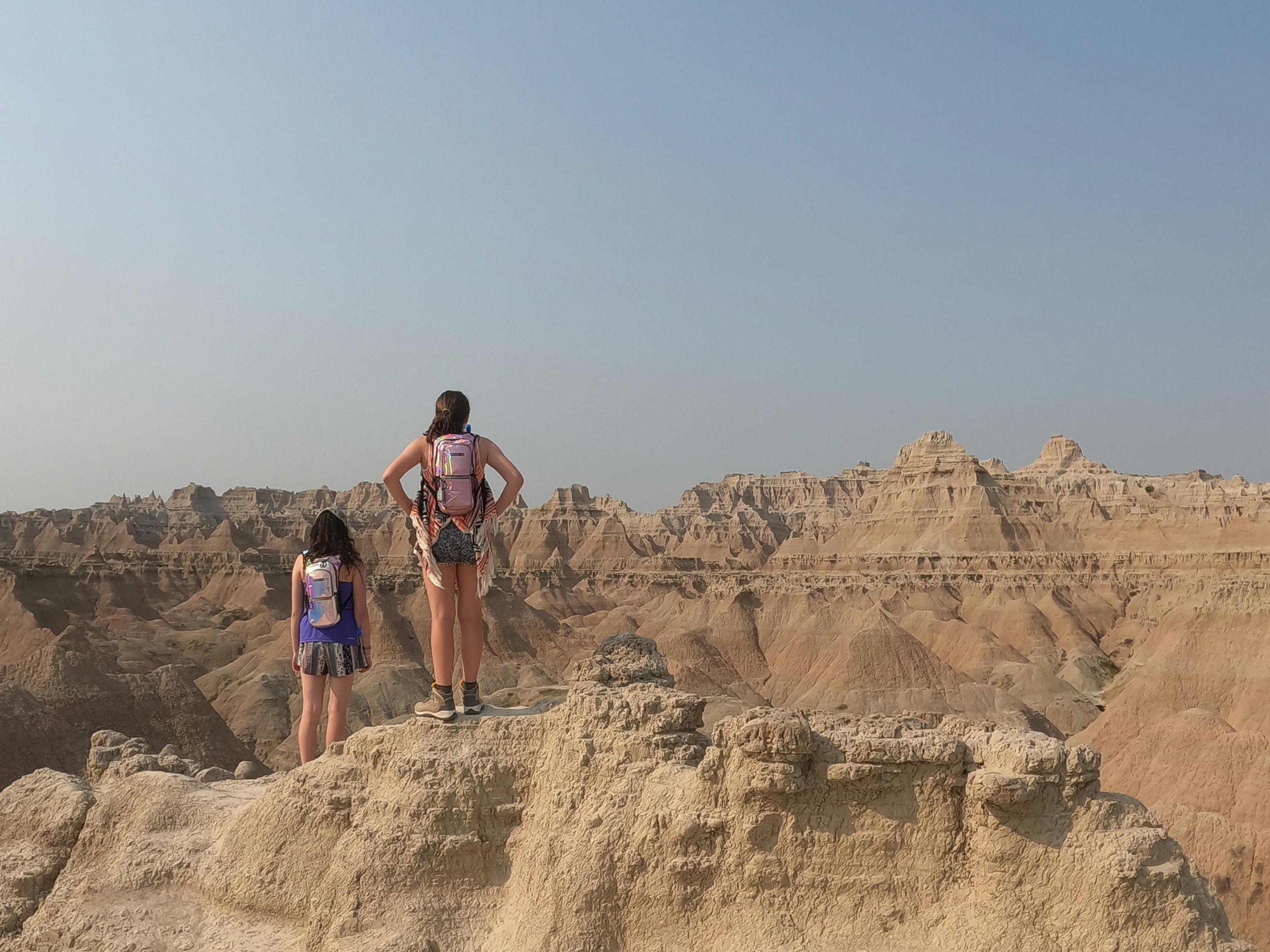
Sunset: The Badlands Notch Trail
The Badlands transform in the final hour of light.
The Notch Trail is dramatic any time of day, but at sunset it becomes something else entirely. The cliffs glow amber and rose. Shadows stretch across ridges. Wind softens. The temperature drops just enough to make the air feel calm and expansive.
You don’t rush a Badlands sunset.
You arrive early.
You sit.
You wait.
The colors do the rest.
Shoulder Seasons: Black Elk Peak in Spring & Fall
Spring and fall are often overlooked — and they’re my favorite times to guide.
Black Elk Peak via the Little Devils route offers granite, forest, and sweeping views. In summer, it can feel crowded. In shoulder seasons, it feels contemplative.
Wildlife moves more in cooler temperatures. The light sits lower in the sky. Trails feel quieter. You can hear your own footsteps.
Spring brings fresh green growth and flowing creeks. Fall brings golden aspen and crisp air.
If you want to experience the Hills at a thoughtful pace, these seasons reward patience.
The Question I Heard 1000 Times
As a ranger, one of the most common questions I heard was:
“How do I see the entire park in four hours?”
It’s an understandable question. Time is limited. Schedules are tight. People want to make the most of their trip.
But the Black Hills — like most meaningful landscapes — aren’t meant to be completed.
They’re meant to be entered.
When you rush from overlook to overlook, you’ll get the photograph. You’ll check the box. You’ll move on.
What you may miss are the smaller moments:
The way wind bends tall grass on the prairie.
The smell of sun-warmed pine bark.
A hawk’s shadow crossing a granite face.
The stillness just before evening light shifts.
Those moments don’t appear on a map.
They appear when you slow down.
Hike With Time, Not Against It
The best hike in the Black Hills isn’t just about trail choice.
It’s about timing.
It’s about light.
It’s about leaving room in the day.
If you build your itinerary around pace instead of volume, the landscape begins to feel less like something you’re trying to conquer — and more like something you’re allowed to step into.
That’s when the Black Hills feel most alive.
Poet’s Table: What 100,000 Messages Taught Me About the Human Heart
Poet’s Table: What 100,000 Messages Taught Me About the Human Heart
There’s a hidden weathered wooden table tucked quietly into the Black Hills.
It isn’t marked on maps. It doesn’t have a grand overlook sign or a visitor center nearby. But for decades, people have found the table off the Little Devil’s Tower trailhead and left something behind.
Names carved into wood.
Initials inside hearts.
Inside jokes.
Declarations of love.
Goofy humor.
Occasionally something inappropriate.
And for a long time, I found myself wondering what it all meant.
During my graduate research, I studied what visitors actually wrote at Poet’s Table. I expected to find romance, rebellion, humor, and identity marking — the usual human impulse to say, “I was here.”
All of that was there.
But something else emerged.
Beyond the love-sick messages and the playful carvings, one phrase appeared again and again:
“Be yourself.”
It surprised me.
In a quiet corner of the Black Hills — surrounded by granite, pine, and sky — people weren’t just marking their presence. They were reminding themselves who they were.
I’ve been there countless times with guests visiting for the first time. I don’t hand them a precise route or a step-by-step set of directions. I simply tell them to use their resources and find it thoughtfully.
Part of the experience is the seeking.
When you have to look a little — pay attention, follow the landscape, trust your sense of place — you arrive differently. You’re more present. More observant. Less rushed.
And that changes what the place gives back.
Over the years, as a National Park Service ranger, I spoke with well over 100,000 visitors. I answered questions about trails, wildlife, geology, and history. But I also watched something deeper unfold.
People soften in these landscapes.
They talk more honestly.
They slow down.
They remember parts of themselves that daily life often buries.
At Poet’s Table, carved into aging wood, that realization shows up plainly:
Be yourself.
Not impress anyone.
Not rush.
Not document every second.
Not optimize the day.
Just be.
The Black Hills have a way of asking that quietly.
When I guide private tours now, I still see that shift happen. It’s rarely dramatic. It’s subtle. A guest lingers at an overlook a little longer. A conversation deepens. Someone stops trying to “see everything” and instead lets the landscape meet them where they are.
The most meaningful moments here are rarely the loudest ones.
They’re the ones where someone looks out across granite spires or prairie light and exhales without realizing they’ve been holding their breath.
Poet’s Table isn’t just a collection of carvings. It’s a record of people encountering something spacious enough to reflect themselves back clearly.
The Black Hills don’t demand that you become something new.
They quietly remind you of who you already are.
And sometimes, that’s more than enough.
You Cannot See a National Park in Four Hours (And Why That’s Okay)
You Cannot See a National Park in Four Hours (And Why That’s Okay)
During my years as a National Park Service ranger, I encountered well over 100,000 visitors.
I spoke with approximately half of them — answering questions, offering directions, explaining geology, and listening to their plans for the day.
And there was one question I heard again and again:
“How do I see the entire park in four hours?”
Sometimes it was Mount Rushmore.
Sometimes it was Custer State Park.
Sometimes it was the Badlands.
But the question was always the same:
How do I see all of it?
It’s an understandable instinct. We’re trained to maximize. To optimize. To fit in one more stop before sunset. Travel becomes a checklist.
Mount Rushmore.
Wildlife Loop.
Needles Highway.
Badlands.
Done.
But the Black Hills — like most meaningful landscapes — don’t reveal themselves that way.
They aren’t meant to be completed.
They’re meant to be entered.
What Gets Missed When We Rush
When we move quickly, we see the obvious:
The monument.
The scenic overlook.
The road sign telling us what we’re looking at.
What we miss are the details that give a place depth.
In Custer State Park, people rush the Wildlife Loop hoping to see a bison herd — but miss the way pronghorn move in quiet arcs across the prairie, or how the light catches the curve of French Creek in late afternoon.
On Needles Highway, they photograph the granite spires but miss the lichen patterns on the rock — bright orange and pale green, growing slowly over decades.
In the Badlands, they stop at Big Badlands Overlook, take the photo, and leave — unaware that just a short walk down the Notch Trail reveals wind-carved ridges that shift color minute by minute as the sun lowers.
At Mount Rushmore, visitors focus on the faces — and often miss the changing light on the surrounding ponderosa forest, the way the granite itself holds subtle shades of pink and gray depending on the hour.
These things are not hidden.
But they require attention.
The Illusion of “Seeing It All”
As a ranger, I often wished I could say it plainly:
You cannot see the entire park in four hours.
But more importantly — you don’t need to.
There is relief in letting go of completion.
When you stop trying to conquer a landscape, you begin to notice it.
Instead of asking:
What’s next?
You begin asking:
What’s happening right here?
The Small Things That Matter
The wind that bends tall prairie grass along Iron Mountain Road.
The scent of sun-warmed pine bark in the afternoon.
The way bison dust themselves in roadside clearings — something you won’t notice if you’re only looking for a “photo opportunity.”
The silence on Black Elk Peak when clouds move across the valley below.
The echo inside a granite tunnel on Needles Highway.
The prairie dogs communicating in quick, high calls that most people mistake for random noise.
None of those moments are on a schedule.
They unfold slowly.
What I Learned From Thousands of Conversations
From the tens of thousands of conversations I had with visitors, I noticed a pattern.
People rarely regretted slowing down.
They regretted rushing.
They regretted not staying five minutes longer at Sylvan Lake.
Not walking just a little farther into Spearfish Canyon.
Not stepping off the main path in the Badlands to feel the wind without the sound of traffic.
The most meaningful experiences weren’t the busiest ones.
They were the quiet ones.
Why Pace Matters
When I guide private tours today, I build the day thoughtfully — but I leave room.
Room for wildlife movement.
Room for light to shift.
Room for conversation.
Room for silence.
If the granite is glowing at 6:42 p.m., we don’t leave at 6:40 because a schedule says so.
If bison are active in a valley, we don’t rush past them to reach the “next stop.”
The Black Hills set the rhythm.
And when you follow that rhythm instead of fighting it, something changes.
You Don’t Need to See Everything
You may not hike every trail.
You may not stop at every overlook.
You may not check every box.
But if you leave having truly noticed something — the wind, the texture of granite, the shift in prairie light, the quiet between bird calls — then you’ve experienced something deeper than a completed itinerary.
The Black Hills are not something to conquer in an afternoon.
They are something to step into — slowly, attentively, and without hurry.
And that is more than enough.
What to Watch (and Listen To) Before Visiting the Black Hills
What to Watch (and Listen To) Before Visiting the Black Hills
Landscapes don’t just shape geography.
They shape stories.
Long before many visitors see the Black Hills in person, they’ve already encountered them through film, music, and myth. Granite spires. Wide prairie. Carved monuments. Endless sky.
Culture prepares us for place — sometimes accurately, sometimes dramatically.
If you’re planning a visit to the Black Hills, here are a few films and pieces of music that quietly set the stage.
North by Northwest (1959)
The final scene of Alfred Hitchcock’s North by Northwest remains one of the most iconic in cinema history.
The Mount Rushmore chase.
Of course, much of the sequence was filmed on a Hollywood set — but the imagery of granite faces towering over human drama has shaped how generations imagine this place.
Watching it before you visit does something interesting: it frames Mount Rushmore not just as a monument, but as a setting. A place where scale dwarfs the individual.
When you stand beneath it in person, you’ll feel that scale in a way film only hints at.
National Treasure: Book of Secrets (2007)
Yes — the secret chamber beneath Mount Rushmore.
No, it doesn’t exist the way the movie portrays it.
But National Treasure 2 captures something real: the sense of mystery people feel when they first see the monument.
It plays on imagination — the idea that history and landscape are layered, and that something might be hidden just out of sight.
The Black Hills have always carried that feeling. Stories of gold rushes. Sacred sites. Presidential carving. Cultural intersections.
The movie dramatizes it.
The landscape grounds it.
Dances with Wolves (1990)
Though filmed in various locations across the region, Dances with Wolves captured the feeling of the prairie — the wide, rolling openness that stretches beyond the granite core of the Hills.
Watch it for the silence.
Watch it for the wind in tall grass.
Watch it for the way distance shapes perspective.
When you drive through the prairie edges of the Black Hills or step into the Badlands at sunset, that sense of space feels familiar — even if you’ve never been there before.
Badlands (1973)
Terrence Malick’s Badlands is moody, sparse, and deeply tied to landscape.
The film doesn’t just use the prairie as backdrop — it lets it breathe.
The openness feels isolating and beautiful at the same time. The sky feels immense. The land feels indifferent and patient.
When you walk the ridgelines of Badlands National Park in late afternoon light, you’ll understand why filmmakers are drawn there.
The landscape does half the storytelling on its own.
Thunderheart (1992)
Filmed partly in South Dakota, Thunderheart explores modern Lakota life and the cultural complexity of the region.
The Black Hills are not only scenic — they are culturally and spiritually significant, especially to the Lakota people.
Understanding that history adds depth to your visit. These are not just rock formations and roads. They are layered landscapes with stories that long predate tourism.
Music for the Black Hills
Film shapes expectation. Music shapes feeling.
Before you visit, consider listening to something that matches the rhythm of wide open land.
Americana and folk artists like Gregory Alan Isakov capture the spacious, reflective mood of the prairie. Instrumental western soundtracks — subtle guitar, open chords, slow builds — echo the scale of granite and sky.
“Home on the Range" an American folk song is widely considered the unofficial anthem of the American West. It was written as a poem in 1872-1873 by Dr. Brewster M. Higley. Famous versions include those by Gene Autry, Bing Crosby, and John Denver.
Even simple acoustic music feels different when paired with long drives through ponderosa forest or across open grassland.
The Black Hills are not loud.
They are expansive.
Music that leaves room between notes fits best here.
Come With Imagination
When you arrive in the Black Hills, you may recognize something you’ve already seen on screen.
But what surprises most visitors is this:
The real landscape feels slower.
Quieter.
More dimensional.
Film dramatizes.
Music interprets.
But the land itself simply exists.
And when you step into it — not rushing, not checking boxes, not chasing the next stop — the experience becomes less cinematic and more personal.
You won’t find a secret chamber beneath Mount Rushmore.
But you may find something else.
A moment of stillness.
A shift in light.
A perspective you didn’t expect.
And that’s better than fiction.